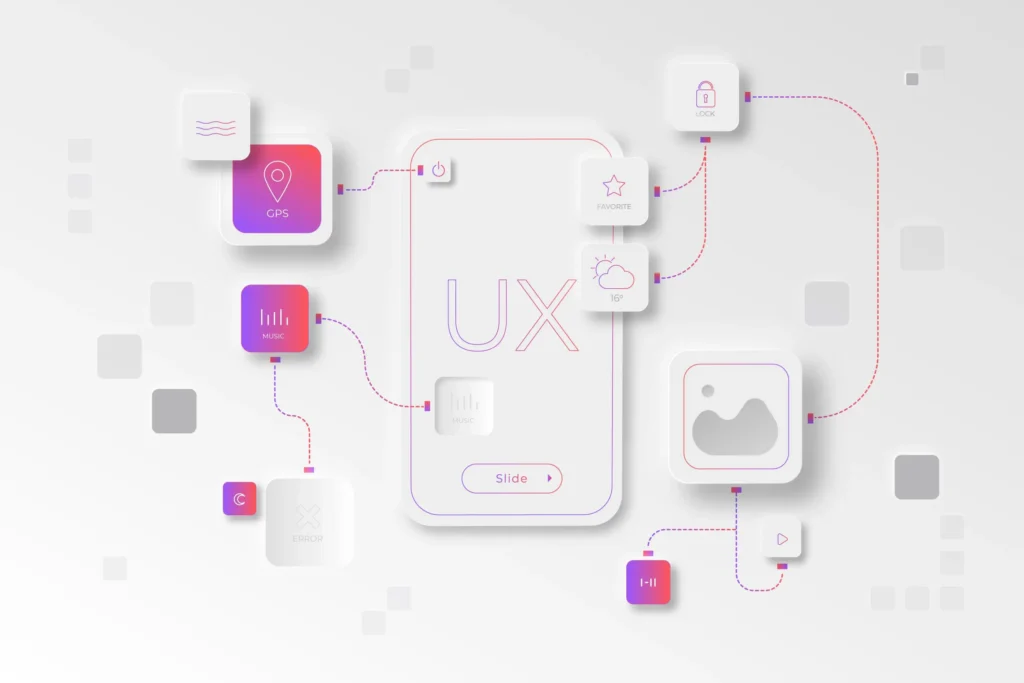
User Experience Design (UX Design) is no longer a “nice to have” skill—it is a business-critical discipline that directly impacts customer satisfaction, retention, and conversion. Whether you are building a website, a mobile app, or a SaaS platform, the quality of the user experience determines how users perceive, adopt, and remain loyal to your product.
What Is User Experience (UX) Design?
User Experience Design is the practice of designing digital (and sometimes physical) products that provide meaningful, relevant, and usable experiences to users.
According to ISO 9241-210, user experience includes:
“A person’s perceptions and responses resulting from the use or anticipated use of a product, system, or service.”
In simpler terms, UX design focuses on how a product works and feels, not just how it looks.
UX design considers:
- How easily users can complete tasks.
- How intuitive the interface feels.
- How accessible and inclusive the product is.
- How users emotionally respond to the experience.
UX Design vs UI Design: Understanding the Difference
UX design is often confused with UI (User Interface) design, but they are distinct disciplines.
| UX Design | UI Design |
|---|---|
| Focuses on user behaviour and experience | Focuses on visual appearance |
| Research-driven | Design-driven |
| Defines structure and flow | Defines colours, typography, and components |
| Solves usability problems | Enhances visual clarity and aesthetics |
UX answers “Why and how does this work?”
UI answers “How does this look and feel visually?”
Both work together, but UX always comes first.
Why User Experience Design Is Important
A strong user experience delivers measurable business value.
1. Improves User Satisfaction: When users can achieve their goals quickly and without frustration, satisfaction increases—and satisfied users return.
2. Reduces Development Costs: Identifying usability issues early through research and testing prevents expensive redesigns later.
3. Increases Conversion Rates: Well-designed UX removes friction from user journeys, leading to higher sign-ups, purchases, and engagement.
4. Builds Brand Trust: A thoughtful experience signals professionalism, reliability, and credibility.
In competitive digital markets, UX is often the differentiator between similar products.
Core Principles of User Experience Design
Understanding UX principles is essential before diving into tools or visuals.
1. User-Centred Design
UX design always begins with the user—not assumptions.
This means:
- Designing for real user needs.
- Validating decisions through research.
- Iterating based on feedback.
A user-centred approach ensures the product solves genuine problems.
2. Usability
Usability measures how easily users can use a product.
Key usability attributes include:
- Learnability.
- Efficiency.
- Error prevention and recovery.
- Satisfaction.
If users struggle to understand or operate a product, UX has failed—regardless of how attractive it looks.
3. Accessibility
Accessible design ensures products can be used by people of all abilities, including those with visual, motor, or cognitive impairments.
UX designers should consider:
- Colour contrast.
- Keyboard navigation.
- Screen reader compatibility.
- WCAG guidelines.
Accessibility is not optional—it is a fundamental UX responsibility.
4. Consistency
Consistency reduces cognitive load by making interfaces predictable.
This applies to:
- Navigation patterns.
- Terminology.
- Layouts.
- Interactions.
Consistent experiences help users feel confident and in control.
5. Simplicity
Good UX removes unnecessary complexity.
Simplicity does not mean fewer features—it means clear prioritisation and focused design.
The UX Design Process: An Overview
While workflows vary, most UX projects follow a structured, iterative process.
1. Research (Empathise)
UX research helps designers understand:
- Who the users are.
- What problems they face.
- How they currently behave.
Common research methods include:
- User interviews.
- Surveys.
- Usability audits.
- Competitive analysis.
Research replaces assumptions with evidence.
2. Define the Problem
Insights from research are synthesised into:
- Problem statements.
- User personas.
- User journey maps.
This step clarifies what problem is worth solving and for whom.
3. Ideation
Designers explore multiple solutions through:
- Brainstorming.
- Sketching.
- Information architecture.
- User flows.
The goal is to think broadly before narrowing down.
4. Wireframing & Prototyping
Wireframes and prototypes translate ideas into tangible layouts and interactions.
- Low-fidelity wireframes focus on structure.
- High-fidelity prototypes simulate real interactions.
Prototypes allow early testing before development.
5. Testing & Iteration
Usability testing validates design decisions with real users.
Testing helps identify:
- Confusing interactions.
- Pain points.
- Opportunities for improvement.
UX design is iterative—design, test, improve, repeat.
Key UX Deliverables
UX designers commonly produce:
- User personas.
- Journey maps.
- Information architecture diagrams.
- Wireframes.
- Interactive prototypes.
- Usability test reports.
Each deliverable supports better decision-making across teams.
UX Design in Real-World Projects
UX design does not exist in isolation. UX designers collaborate closely with:
- Product managers.
- UI designers.
- Developers.
- Business stakeholders.
- Marketing teams.
Effective UX balances:
- User needs.
- Business goals.
- Technical constraints.
This collaboration ensures solutions are both usable and feasible.
The Role of UX Designers Today
Modern UX designers are problem solvers, not just screen designers.
They are expected to:
- Think strategically.
- Use data and research.
- Advocate for users.
- Align design with business outcomes.
- Work within agile and sprint-based environments.
As digital products grow more complex, UX designers play a critical role in shaping meaningful experiences.
UX design continues to evolve with:
UX Design and the Future
- Artificial Intelligence (AI).
- Voice and conversational interfaces.
- Inclusive and equity-focused design.
- Ethical design practices.
However, the fundamentals remain unchanged: understand users, solve real problems, and design with empathy.
Final Thoughts
The basics of User Experience Design form the foundation for all successful digital products. UX is not about decoration—it is about intentional, evidence-based decision-making that improves how people interact with technology.
Whether you are a business owner, a developer, or an aspiring designer, understanding UX principles helps create products that are usable, accessible, and valuable.
A strong user experience is not accidental—it is designed.
Want to explore UX design in practice?
Follow this blog for in-depth articles on UX processes, tools, case studies, and real-world design strategies.