The digital product development life cycle is the structured process through which a digital product evolves—from an initial idea to a fully launched and continuously improved solution. Whether the product is a mobile app, web platform, or SaaS tool, understanding this life cycle is essential for creating products that are not only functional, but also usable, scalable, and valuable to users.
What Is the Digital Product Development Life Cycle?
The digital product development life cycle (DPDLC) is a series of stages that guide teams in planning, designing, building, launching, and improving digital products.
Unlike traditional linear development models, modern digital product life cycles are:
The goal is not just to ship features, but to continuously deliver value to users.
Why the Product Development Life Cycle Matters
A clearly defined life cycle helps teams:
- Reduce risk and uncertainty.
- Align stakeholders around shared goals.
- Integrate UX, technology, and business strategy.
- Respond effectively to user feedback and market changes.
Products that skip or rush stages often suffer from poor usability, misaligned features, and low adoption.
Key Stages of the Digital Product Development Life Cycle
While terminology may vary across organisations, most digital products follow these core stages.
1. Ideation and Discovery
The life cycle begins with identifying a problem worth solving.
Objectives of This Stage
- Understand the market opportunity.
- Identify user pain points.
- Define the product vision.
Key Activities
- Stakeholder interviews.
- Market and competitor analysis.
- User research and discovery interviews.
- Problem framing and hypothesis creation.
At this stage, UX designers play a critical role in ensuring the product idea is grounded in real user needs rather than assumptions.
2. Product Strategy and Planning
Once a viable problem is identified, teams move into strategic planning.
Objectives
- Define the product’s purpose and success criteria.
- Align user goals with business objectives.
- Prioritise features and scope.
Key Outputs
- Product vision statement.
- Value proposition.
- User personas.
- High-level user journeys.
- Product roadmap.
Good UX input at this stage prevents feature bloat and ensures the product focuses on outcomes rather than functionality alone.
3. UX Research and Experience Design
This stage focuses on shaping how the product will work from a user’s perspective.
UX Responsibilities
- Conduct in-depth user research.
- Define information architecture.
- Design user flows and task paths.
- Validate assumptions through testing.
UX designers translate strategy into experience, ensuring the product structure supports intuitive and efficient use.
4. Wireframing and Prototyping
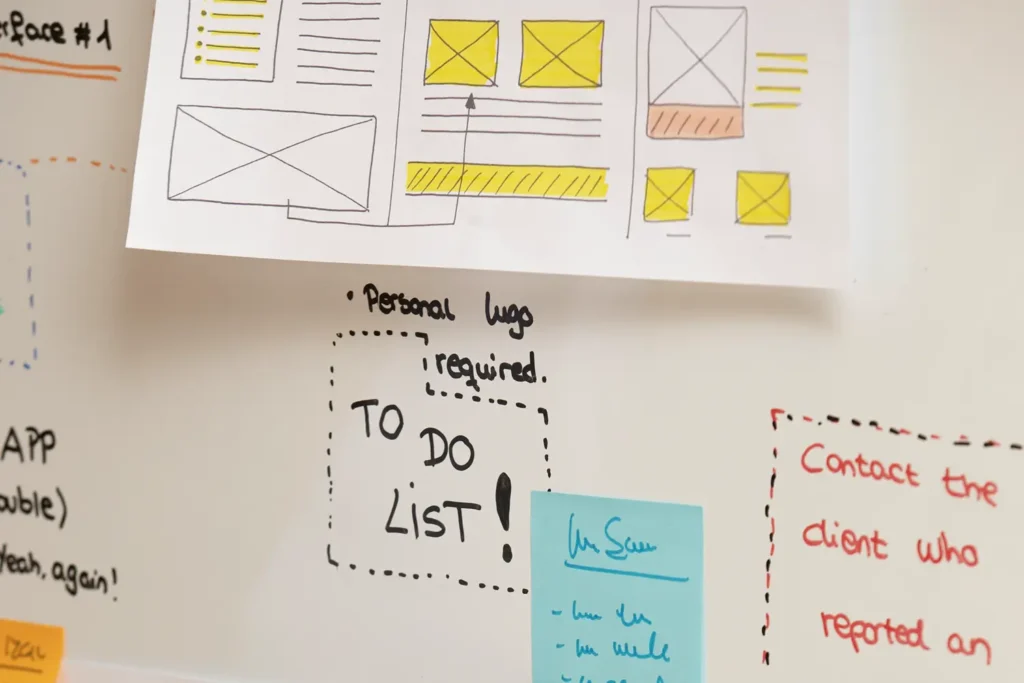
Wireframes and prototypes bring ideas to life in a tangible form.
Purpose
- Visualise structure and layout.
- Test usability early.
- Reduce development risk.
Types of Artefacts
- Low-fidelity wireframes for structure.
- Mid-fidelity flows for interaction logic.
- High-fidelity prototypes for usability testing.
Prototyping allows teams to identify usability issues before development begins, saving time and cost.
5. UI Design and Design Systems
Once the experience structure is validated, the focus shifts to interface design.
Key Considerations
- Visual hierarchy and clarity.
- Brand alignment.
- Consistency across screens.
- Accessibility standards.
Design systems are often created or extended at this stage to ensure scalability and consistency as the product grows.
Good UI design supports UX by enhancing clarity, not distracting from functionality.
6. Development and Implementation
This is where designs are translated into working software.
Collaboration Is Critical
UX designers collaborate closely with:
- Front-end developers.
- Back-end engineers.
- Product managers.
- QA teams.
Design specifications, prototypes, and documentation ensure the intended experience is preserved during implementation.
UX involvement during development helps address feasibility issues and prevents experience degradation.
7. Testing and Quality Assurance
Before launch, the product undergoes rigorous testing.
Types of Testing
- Functional testing.
- Usability testing.
- Accessibility testing.
- Performance testing.
UX designers often conduct or support usability testing to validate that real users can complete tasks successfully in the near-final product.
8. Launch and Go-To-Market
Product launch is not the end—it is the beginning of real-world learning.
Key Activities
- Deployment and release management.
- Onboarding experience design.
- Analytics setup.
- Initial user feedback collection.
A well-designed onboarding experience is critical for first impressions and early adoption.
9. Post-Launch Evaluation and Iteration
After launch, teams monitor how users interact with the product.
UX Metrics Commonly Tracked
- Task success rates.
- Drop-off points.
- Engagement metrics.
- User feedback and support tickets.
Insights from real usage data inform future improvements, refinements, and new feature development.
This stage reinforces the iterative nature of the digital product life cycle.
Agile and the Digital Product Development Life Cycle
Most modern digital products are built using agile or hybrid agile methodologies.
How Agile Supports UX
- Continuous feedback loops.
- Incremental releases.
- Ongoing usability testing.
- Cross-functional collaboration.
Rather than following a rigid sequence, agile teams revisit stages of the life cycle repeatedly as the product evolves.
The Role of UX Designers Across the Life Cycle
UX designers are involved throughout the entire product life cycle—not just during design phases.
They contribute by:
- Advocating for user needs.
- Translating research into actionable insights.
- Aligning design decisions with business goals.
- Ensuring accessibility and usability standards.
- Measuring and improving experience over time.
Strong UX maturity is often reflected in how early and consistently designers are involved.
Common Mistakes in Digital Product Development
Some frequent issues that undermine product success include:
- Skipping discovery and research.
- Designing without validation.
- Treating UX as a final polish step.
- Launching without clear success metrics.
- Ignoring post-launch feedback.
Avoiding these mistakes requires discipline, collaboration, and a user-first mindset.
Why UX-Centred Life Cycles Lead to Better Products
When UX is integrated throughout the digital product development life cycle:
- Products solve real problems.
- Experiences feel intuitive and coherent.
- Development efforts are better prioritised.
- Users trust and adopt products more readily.
UX-centred life cycles reduce risk while increasing long-term value.
Final Thoughts
The digital product development life cycle provides a structured yet flexible framework for building meaningful digital products. While tools, technologies, and methodologies continue to evolve, the core principle remains unchanged: successful products are built by understanding users and iterating based on real-world feedback.
For UX designers, mastering the product life cycle is essential—not only to design better experiences, but to influence strategy, collaboration, and outcomes at every stage.